Top Sustainability and ESG Interview Questions and Answers

Written by Matthew Hale
- Is Sustainability Still a Good Career Bet?
- How to Start a Career in Sustainability With No Experience
- Core Sustainability and ESG Interview Questions and Answers
- Advanced ESG Interview Questions
- ESG Case Study Interview Questions (With Sample Approaches)
- Where a Sustainability Certification Fits In
- Conclusion
If you've got a sustainability or ESG interview coming up, you've probably noticed something already: these conversations don't run the way they used to. A few years back, "tell me about ESG" could carry most of the interview. Now hiring managers want you to run a materiality assessment out loud, defend a Scope 3 number, or work through a case study without freezing up.
This blog is built around that shift. You'll find the core sustainability interview questions and answers professionals still get asked, a full section of ESG case study interview questions (the part most guides skip entirely), a set of sample ESG certification exam questions if that's what you're actually prepping for, and an honest look at whether sustainability is still worth betting a career on.
Is Sustainability Still a Good Career Bet?
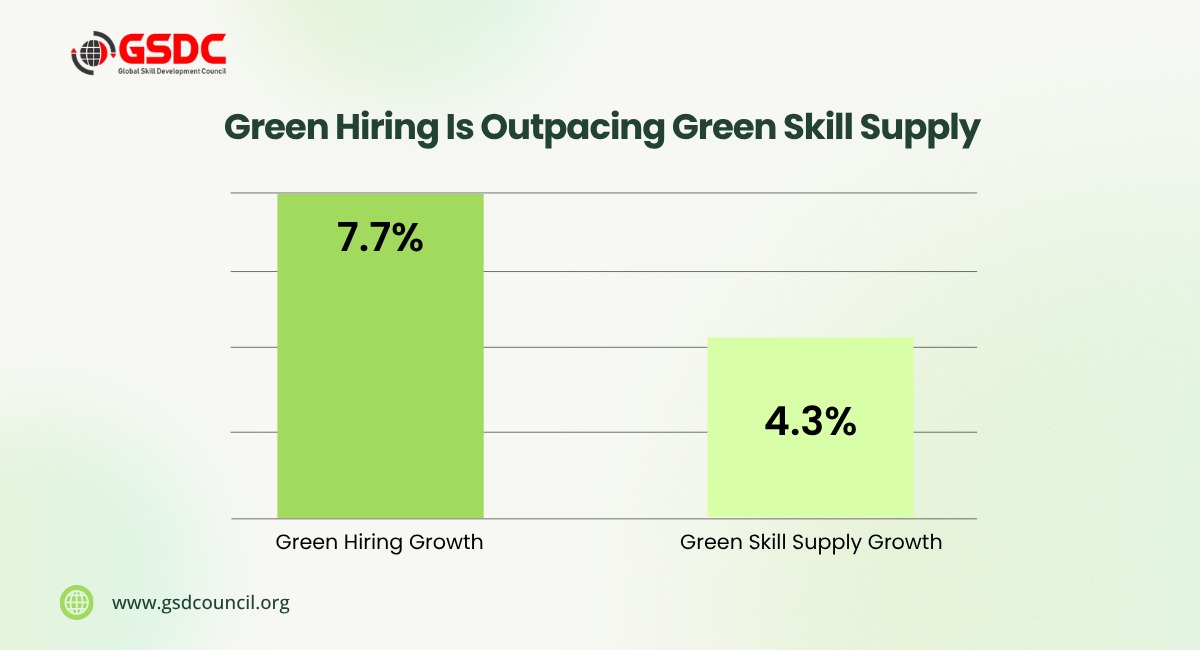
Short answer: yes. LinkedIn's Global Green Skills Report 2025 found green hiring growing nearly twice as fast as the supply of people with green skills, and for the first time, most green hires are landing in roles that never used to require sustainability knowledge: finance, procurement, product, operations. It's stopped being a niche department and become a layer on top of most jobs.
The clearest signal, though, comes from an unexpected place: BLS projections show wind turbine technicians and solar installers as the two fastest-growing occupations in the entire U.S. economy through 2034, not just the fastest-growing green jobs. Renewable energy work isn't out-competing other green careers, it's out-competing every career the BLS tracks.
So if you're weighing sustainability against something more conventional, you're not making a sentimental call.
How to Start a Career in Sustainability With No Experience
This is the question we get asked most, so here's the direct version.
- Pick a lane before you pick a job title. "Sustainability" spans climate risk, circular economy, ESG reporting, supply chain, and energy management, and narrowing your focus makes you a much easier hire.
- Get fluent in the frameworks employers actually reference, since GRI, SASB, TCFD, and the UN SDGs come up constantly, even in interviews for roles that don't have "ESG" anywhere in the title.
- Build a portfolio, not just a resume, even a self-initiated case study like a mini materiality assessment for a company you admire, to show you can apply the theory instead of just reciting it.
- Get certified, since a recognized credential like GSDC's Certified Sustainability Professional compresses the learning curve and gives a recruiter a reason to trust you faster.
- Target adjacent industries, not just "green" companies, as technology and financial services are both pulling sustainability expertise into roles that never used to need it.
Beyond the obvious "ESG Analyst" title, look at sustainable procurement lead, climate risk associate, ESG data analyst, CSR manager, and sustainability communications specialist. The job titles are multiplying faster than most boards can keep up with.
Core Sustainability and ESG Interview Questions and Answers
These are the fundamentals every sustainability and ESG interview still opens with. Don't skip past them because they sound basic. Interviewers use them to check whether your understanding holds up once they ask a follow-up, and bodies like the Global Skill Development Council (GSDC) build their certification curricula around this same core list, so getting comfortable here does double duty.
Q1. What does sustainability mean in a corporate context?
Building environmental, social, and economic thinking into everyday business decisions so a company performs well over the long run, not just this quarter. That means cutting waste, using resources wisely, treating people fairly, and staying profitable without borrowing against the future.
Q2. What's the actual difference between ESG and sustainability?
Sustainability is the goal: running a business in a way the planet and society can sustain over time. ESG is the accountability framework on top of it, a defined set of environmental, social, and governance metrics that let investors and regulators check whether the sustainability claims hold up.
Q3. Why does ESG matter to modern organizations?
Because non-financial and financial performance aren't as separate as they used to be. Strong ESG practices lower regulatory risk, attract investors who screen for it, and protect brand reputation in a market where transparency isn't optional.
Q4. What are the core pillars of sustainability?
Environmental (resource use, emissions, ecosystem impact), Social (labor practices, community wellbeing, human rights), and Economic (ethical, durable profitability). None work in isolation; a company that nails one while ignoring the others isn't sustainable in any meaningful sense.
Q5. Name a few sustainability frameworks and what they're for.
GRI, SASB, TCFD, and the UN SDGs are the ones you'll hear most, and each does a different job. GRI covers broad, stakeholder-facing reporting. SASB narrows in on ESG issues most likely to affect financials, industry by industry, for investors. TCFD's recommendations, now incorporated into the ISSB's global sustainability disclosure standards, focus on climate-related financial risk. The UN SDGs aren't a reporting standard at all, they're global development goals companies map initiatives against.
Q6. What are common sustainability KPIs?
Greenhouse gas reduction, renewable energy share, waste diversion rate, water-use efficiency, and community engagement metrics, turning a vague commitment into something trackable quarter over quarter.
Q7. How do organizations actually implement sustainability best practices?
Start with a materiality assessment to identify which ESG issues matter most to stakeholders and the business. Then it's cross-department buy-in, employee training, clear targets, and public reporting so the commitment doesn't quietly disappear.
Q8. How do ISO standards fit into sustainability?
ISO 14001 (environmental management) and ISO 45001 (occupational safety) give companies a repeatable structure for managing impact and proving continuous improvement instead of just claiming it.
Q9. What's CSR's role in all this?
CSR is sustainability in action: the community programs, ethical sourcing, and inclusive growth efforts that put the strategy into practice and build public trust.
Q10. How does sustainability governance actually work inside a large organization? Through board committees, sustainability councils, and internal audit functions that check progress against commitments, so it stays accountable rather than staying a slide deck.
"What Does Sustainability Mean to You?": How to Actually Answer This
This one deserves its own section because it trips up more candidates than any technical question on the list. Interviewers ask it precisely because there's no textbook answer. They want to know if you've internalized the concept or just memorized a definition.
The mistake most candidates make is reciting the three-pillars answer word for word, like they're back in a certification exam. Instead:
- Anchor it to something specific you've done or seen: a project, a habit, a company decision you respected or disagreed with.
- Connect it to business outcomes, not just idealism. Interviewers want to know you see sustainability as strategy, not sentiment.
- Keep it under 90 seconds. This is a warm-up question, not the main event. A long answer here reads as unprepared, not passionate.
A strong version might sound like: "To me, sustainability means making decisions today that a company won't have to apologize for in ten years, whether that's how it sources materials or how it treats its people. I got interested in this after working on [specific example], and it's shaped how I evaluate every project since."
Advanced ESG Interview Questions
Once the basics are confirmed, interviewers move into judgment territory: how you'd actually operate under pressure or ambiguity.
Q11. How is sustainability performance measured and reported?
Emissions are measured against the GHG Protocol (Scope 1, 2, and 3), alongside water usage, diversity data, and waste figures, then disclosed through frameworks like GRI. The strongest reports tie those numbers back to the financial statements.
Q12. How do you align sustainability goals with business strategy?
By mapping ESG objectives onto business outcomes, such as renewable energy tied to cost savings or diversity tied to innovation output. When sustainability and profit point the same direction, the strategy sticks.
Q13. What is a materiality assessment?
Identifying which ESG issues matter most to both stakeholders and business performance, usually through surveys, data collection, and peer benchmarking. The output, a materiality matrix, tells you where to focus first.
Q14. How is sustainability built into supply chains?
Through supplier codes of conduct covering emissions, labor conditions, and transparency, backed by audits and capacity-building rather than cutting ties the moment something goes wrong.
Q15. Which frameworks guide climate-risk assessment?
TCFD's recommendations, now incorporated into the ISSB's global sustainability disclosure standards (specifically IFRS S2), which separate physical risk (extreme weather, resource scarcity) from transition risk (policy shifts, changing technology costs).
Q16. How do technology and data support sustainability?
AI analytics estimate carbon footprints, IoT sensors track energy use in real time, and blockchain increasingly verifies supply-chain claims. Worth noting: the technology sector itself shows the strongest sustained growth in green hiring of any industry.
Q17. What role do leadership and culture play?
Leadership sets the tone and accountability; culture determines whether ESG targets get lived out day to day or stay a line item in the annual report. Embedding sustainability into leadership KPIs closes that gap.
Q18. How should stakeholder communication be handled?
Transparently and tailored to the audience: investors want numbers, employees want relevance, regulators want compliance evidence. Regular reporting builds trust, not one polished annual report.
Q19. How do you handle resistance to sustainability initiatives?
Lead with the business case (cost savings, risk reduction, reputational upside) rather than the moral argument alone. Data and small early wins convert skeptics faster than idealism does.
Q20. What's changing in ESG regulation right now, and why should candidates know it? This has shifted more in the past year than in the previous five. In the EU, the CSRD Omnibus amending directive entered into force in March 2026, narrowing CSRD's scope to companies with more than 1,000 employees and over €450 million in net turnover, a significant cut from the original thresholds, while leaving the reporting framework itself intact. In the U.S., the SEC withdrew its legal defense of the 2024 federal climate disclosure rule in March 2025 and by mid-2026 had begun formally moving to rescind it. This area moves fast, so confirm current status before citing a specific figure in an interview. State-level rules like California's and the global ISSB standards are filling some of the gap in the meantime.
Q21. How can circular-economy principles be applied in business?
By designing products for reuse, repair, or recycling from the start rather than treating waste reduction as an afterthought. It cuts raw material dependency and often uncovers cost savings nobody was looking for.
Q22. What's the significance of a life-cycle assessment (LCA)?
An LCA quantifies environmental impact across a product's entire life, from raw material extraction through disposal, so companies know exactly where their biggest impact sits.
Q23. How does employee engagement drive sustainability results?
Employees who feel ownership over sustainability goals, through green teams, training, or recognition programs, tend to surface ideas leadership would never spot from the top down.
Q24. How do organizations ensure transparency in ESG disclosures?
Standardized metrics, independent third-party audits, and open access to the underlying data. Transparency isn't a PR statement, it's a verification process.
ESG Case Study Interview Questions (With Sample Approaches)
This is where most candidates get caught off guard. An ESG case study interview doesn't test what you know, it tests whether you can apply it under a bit of pressure, with incomplete information, in front of someone watching how you think. Here are the formats you're most likely to see, along with how to structure your response.
Case 1: "A manufacturing client's Scope 3 emissions have spiked 20% year over year, but their Scope 1 and 2 numbers look fine. Walk me through how you'd investigate this."
Structure your answer around the supply chain, not internal operations. Scope 3 usually means the issue sits with suppliers, logistics, or purchased goods. Mention breaking the number down by category (purchased goods, transportation, use of sold products), identifying the biggest contributors first, and engaging suppliers directly rather than assuming the data is wrong.
Case 2: "You're advising a retail company that wants to publish an ESG report for the first time. Where do you start?"
Lead with a materiality assessment before anything else. You can't report meaningfully on issues you haven't prioritized. Then talk data collection systems, framework selection (GRI is usually the sensible pick for a first-timer), and a realistic first-year scope rather than promising a perfect report on day one.
Case 3: "A company's ESG rating just dropped despite genuine sustainability investment. How do you explain that to the board?"
This tests whether you understand that ESG ratings often lag disclosure quality rather than actual performance. A good answer covers reporting transparency gaps, benchmarking against how competitors disclose the same data, and recommending a communications fix alongside any operational one.
Case 4: "You have a limited sustainability budget and three competing priorities: emissions reduction, supplier audits, and employee training. How do you decide?"
This is a prioritization test, not a right-answer test. Reference the materiality matrix, weighing which issue is most material to stakeholders and business risk, and be explicit that you'd quantify trade-offs rather than go with instinct.
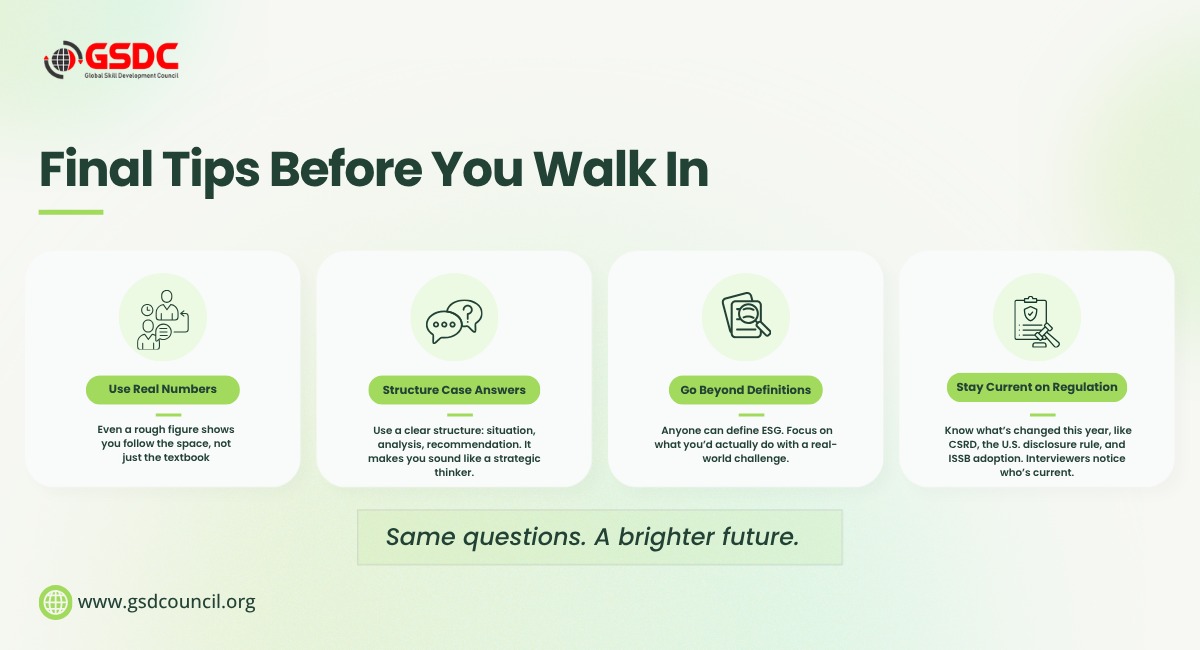
If you take one thing from this section: interviewers running an ESG case study aren't grading you on a perfect answer. They're grading how you structure ambiguity. Narrate your thinking out loud, name your assumptions, and it reads as competence even when you don't have every fact.
Where a Sustainability Certification Fits In
A sustainability certification does something a self-taught resume line can't: it gives a recruiter a fast, credible signal when they're screening two hundred applications. It won't get you the job on its own, but it puts you on the right side of the first cut, and given how far green hiring is outpacing green skills supply industry-wide, that first cut matters more than it used to. If you're weighing whether to add a credential to your prep, GSDC's Certified Sustainability Professional program is one option built around the frameworks that actually come up in these interviews: sustainability strategy, ESG implementation, and performance measurement. It won't replace hands-on experience, but paired with it, a recognized certification gives a recruiter a faster reason to take your application seriously.

Conclusion
A sustainability or ESG interview today isn't testing whether you can define terms. It's testing whether you can think like someone who'd actually be trusted with a real ESG program: knowing the frameworks, yes, but also walking through a case study, defending a number under scrutiny, and knowing what's shifted in the regulatory landscape this year rather than reciting what was true a few years back.
Between the widening green skills gap, the growth of sustainability capability inside traditionally non-green roles, and the steady churn in global ESG regulation, this isn't a field you need to talk yourself into. Prepare well, get certified if it fits your path, and walk in like someone who's already doing the job, not just applying for it.

Related Certifications
Stay up-to-date with the latest news, trends, and resources in GSDC
If you like this read then make sure to check out our previous blogs: Cracking Onboarding Challenges: Fresher Success Unveiled
Not sure which certification to pursue? Our advisors will help you decide!