IT Asset Manager Interview Questions and Answers
Written by Emily Hilton
Hiring an IT asset manager is rarely about finding someone who can keep a spreadsheet tidy. The person in this seat decides how hardware, software licences, cloud services and SaaS subscriptions are tracked, paid for and retired, and a weak hire shows up quickly as audit fines, wasted spend and gaps nobody can explain.
This blog covers 12 IT asset manager interview questions in three groups (general, technical and behavioural), with a note on what a strong answer sounds like. It works from both sides of the table: hiring managers get a ready question set, and candidates get a clear picture of what good answers include. The job description, process, best practices, salary and certification options are covered along the way.
One clarification for anyone searching for asset management interview questions: those aimed at investment firms cover portfolios and markets. This guide is about IT asset management, the discipline of managing technology assets across their lifecycle.
What Does an IT Asset Manager Do?
An IT asset manager owns the record of what technology an organisation has, who uses it, what it costs and when it needs to be renewed or retired. A typical IT asset manager job description includes:
- Tracking hardware, software, cloud and SaaS assets from purchase to disposal
- Matching software licence entitlements to actual usage to avoid penalties
- Maintaining the asset database and its link to the configuration management database (CMDB)
- Cutting waste by reclaiming unused licences and redeploying spare equipment
- Preparing for vendor audits and supporting renewals and negotiations
- Working with procurement, finance, security and service desk teams
- Reporting on cost, risk and utilisation to IT leadership
For a fuller breakdown, see this guide to IT asset manager roles and responsibilities.
The IT Asset Management Process in Brief
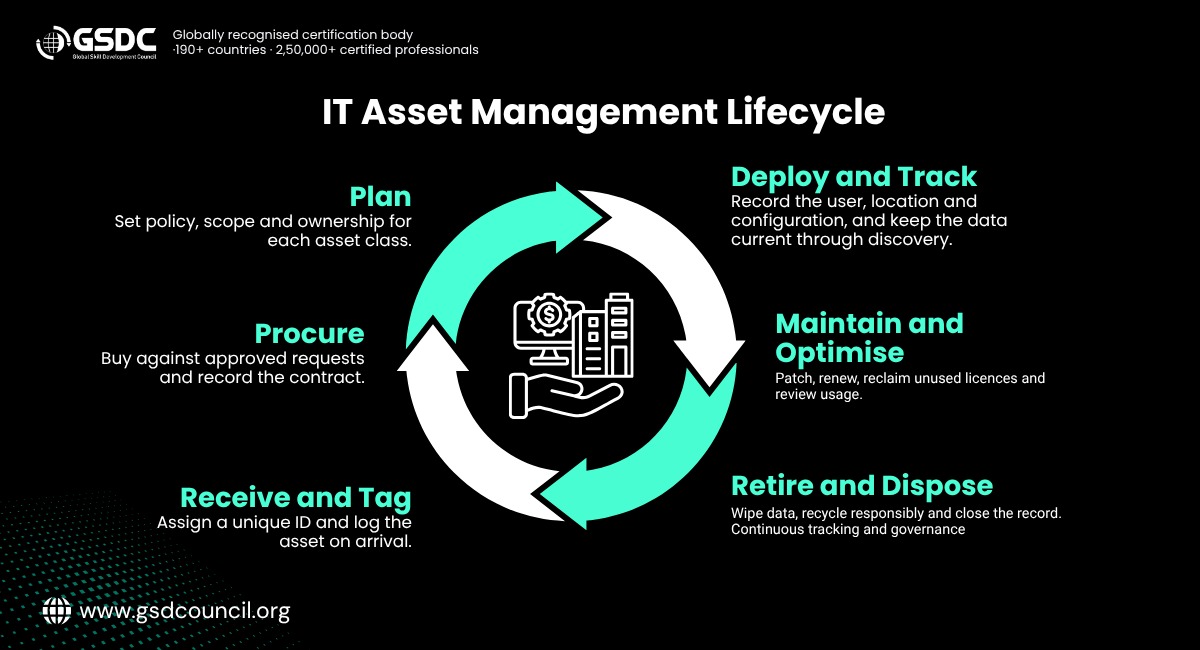
The IT asset management process follows the life of an asset. Most programmes work through six stages:
- Plan: set policy, scope and ownership for each asset class
- Procure: buy against approved requests and record the contract
- Receive and tag: assign a unique ID and log the asset on arrival
- Deploy and track: record the user, location and configuration, and keep the data current through discovery
- Maintain and optimise: patch, renew, reclaim unused licences and review usage
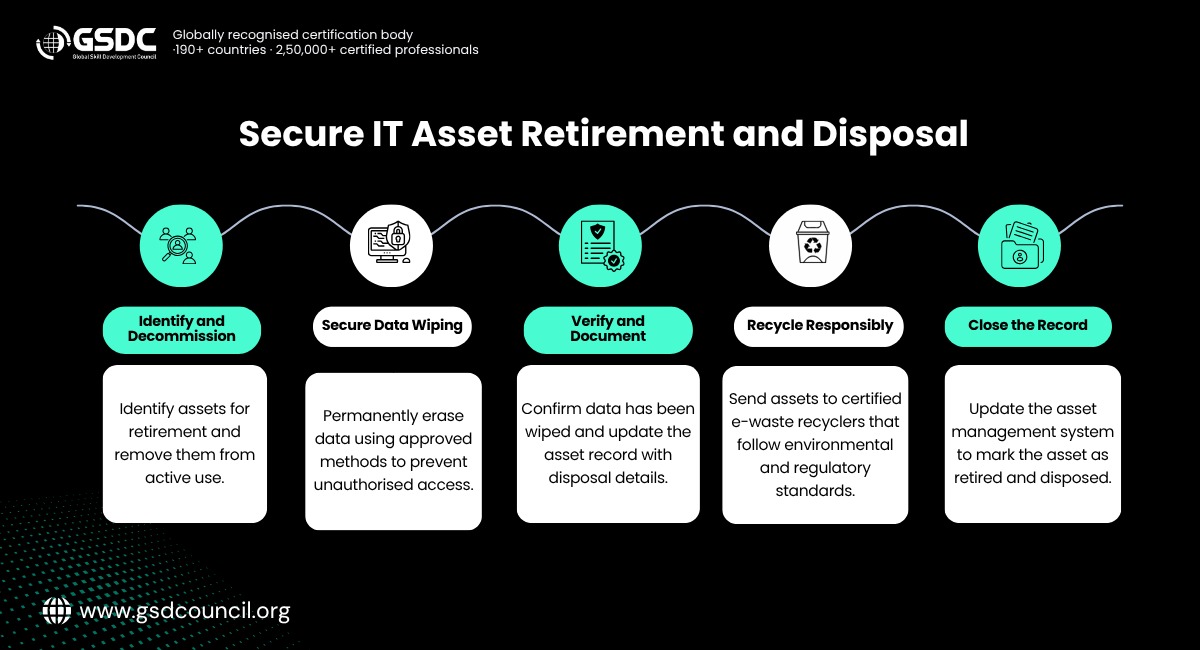
- Retire and dispose: wipe data, recycle responsibly and close the record
Most of the questions below test how well a candidate understands one or more of these stages.
IT Asset Management Interview Questions for Professionals
Each question includes what a strong answer tends to cover. Hiring managers can adapt the list to the size and setup of the organisation, and candidates can use it to rehearse.
General Interview Questions
These questions give a broad view of a candidate's experience and approach.
1. What experience does the candidate have managing IT assets across their lifecycle?
This opens the conversation and shows how the candidate describes their own work. A strong answer walks through procurement, deployment, maintenance and retirement, names the tools used at each step and gives scale, such as how many assets and which types. One concrete result, like a cleaner inventory or a lower renewal bill, carries more weight than a list of job titles. A vague answer about tracking assets with no method behind it is a warning sign.
2. How is compliance with software licensing agreements maintained?
Licence mistakes are expensive, so this question separates careful candidates from casual ones. Strong answers describe keeping an entitlement record (what was bought) beside a usage record (what is installed or consumed), reconciling the two on a schedule and fixing gaps before a vendor audit forces the issue. Mentioning true-up risk, over-licensing and contract terms such as metrics and use rights shows real commercial awareness.
3. Which strategies improve IT asset utilisation?
Good answers go well beyond buying less. Typical examples include reclaiming unused licences, right-sizing cloud instances, setting refresh cycles by use instead of age, pooling spare hardware and consolidating overlapping tools. The best answers tie each tactic to a measured saving, because utilisation work only counts when someone can show the number moved.
Technical Interview Questions
These questions reveal hands-on knowledge of systems and methods.
4. Which IT asset management tools have been used, and how were they set up?
Platforms such as ServiceNow, BMC Helix (formerly Remedy) and Lansweeper come up often. The tool matters less than the thinking behind it. A strong answer explains how discovery feeds the asset record, how the data connects to the CMDB and procurement systems, and how data quality was kept high after go-live. Candidates who blame the tool for bad data have often not owned the process.
5. How is an IT asset inventory carried out?
The expected path is discovery, data collection and reconciliation. Strong answers add the details that make an inventory trustworthy: unique asset IDs, a named owner for every record, scheduled audits and a clear way to handle exceptions such as unmanaged devices and shadow IT. Accuracy and repeatability matter more than a one-off clean-up. The basics of this process are covered at foundation level, for example in IT Asset Management Foundation (ITAMF).
6. How is the disposal of IT assets handled?
Disposal is a data security and legal issue as well as an environmental one. A strong answer covers verified data wiping aligned with recognised guidance such as NIST SP 800-88, certificates of destruction, certified recycling partners, chain of custody and compliance with local e-waste rules. It ends with the record being closed in the asset database.
7. How is visibility maintained across SaaS, cloud and AI tools?
This question separates modern candidates from legacy ones. Flexera's latest State of ITAM survey of 512 professionals found that only 36% of organisations report complete visibility across their IT estate, and only 31% have accurate visibility into AI software. Strong answers combine discovery tools with procurement, finance and identity data (such as single sign-on logs), flag shadow IT early and keep a renewal calendar so nothing auto-renews unnoticed.
8. How is a software audit prepared for?
The best answers treat preparation as a continuous habit instead of a scramble. That means a central repository for contracts and proof of entitlement, regular internal compliance checks, a defined response process involving legal and procurement, and a single point of contact for the vendor. A candidate who has been through a real audit and can describe what was learned sends a strong signal. Structured learning can help here too, and GSDC is among the bodies offering programmes on IT asset management and the ISO/IEC 19770 standard family.
Behavioural Interview Questions
These questions show how candidates handle real-world pressure and working relationships.
9. How was a conflict with a team member or stakeholder resolved?
Asset managers often ask other teams to give something up: a reclaimed licence, an older laptop, an unapproved tool. Strong answers describe a specific disagreement, the data used to make the case and the working relationship afterwards. Look for ownership of the outcome instead of blame.
10. How are multiple projects prioritised at the same time?
Typical competing priorities include a hardware refresh, a licence renewal and an upcoming audit. Good answers explain a method, such as ranking by risk, deadline and business impact, and describe how stakeholders were told what would be delayed and why.
11. Describe a time an asset record turned out to be wrong. What changed afterwards?
Every asset database has errors. A strong answer traces the root cause, such as a missing handover step or unmanaged devices, then describes a process fix instead of a one-off clean-up. It shows whether a candidate treats data quality as a habit or a chore.
12. How is knowledge kept current in IT asset management?
The field now spans cloud, SaaS and AI as well as hardware. Good answers point to specific habits: following vendor licensing changes, reading industry research, joining practitioner communities and studying standards such as ISO/IEC 19770-1. Named sources and recent examples are more convincing than a general claim of staying informed.
IT Asset Management Best Practices
Interview answers land best when they reflect how mature programmes actually run. These are the IT asset management best practices that come up most often:
- Keep one source of truth for every asset class, including cloud, SaaS and AI tools
- Assign a unique ID and a named owner at the point of purchase
- Automate discovery and reconcile it against purchase and contract records
- Match licence entitlements to real usage on a regular schedule
- Set lifecycle policies for refresh, reassignment and retirement
- Involve procurement, finance and security so records stay accurate
- Review data quality regularly and fix root causes, not symptoms
Candidates who can link their past work to these habits usually give the most convincing answers.
IT Asset Manager Salary
Pay is one of the most searched questions around the role. Glassdoor's US data shows a median total pay of about $113,000 a year for an IT asset manager, with the typical range running from roughly $88,000 to $145,000. These figures are self-reported, so they work best as a guide rather than a promise.
Pay typically moves with seniority, location, industry and whether the role covers software licensing, cloud and SaaS instead of hardware alone. Outside the US, local salary surveys give a more accurate picture.
ITAM Certification: Does It Matter?

No single ITAM certification is required to work as an IT asset manager, and hands-on evidence still counts most. A certification does show that a candidate understands lifecycle management, licensing and governance concepts, which helps career changers and early-career professionals in particular. For hiring teams, it works as one signal next to the answers above, not a replacement for them.
An IT asset management certification at foundation level is a sensible starting point, and GSDC's IT Asset Management Foundation covers the basics of managing IT assets efficiently. Candidates aiming higher often add knowledge of standards such as ISO/IEC 19770-1, which sets requirements for an IT asset management system.
Conclusion
Good IT asset manager interview questions test three things: how well a candidate understands the asset lifecycle, how compliance and data are handled under pressure, and how well the candidate works with the teams that depend on accurate records. The list should be adjusted to the organisation, since a company heavy on SaaS needs different depth from one running large hardware fleets.
Taking the time to prepare structured questions up front costs little compared with a poor hire in a role that touches every technology budget.

Related Certifications
Frequently Asked Questions
Experience across the asset lifecycle, licence compliance, tools and CMDB integration, inventory, disposal, audits, and handling conflict or competing priorities.
The role tracks technology assets from purchase to retirement, keeps licences compliant, cuts waste and reports on cost and risk to IT leadership.
Glassdoor's US data shows a median of about $113,000 a year, with a typical range of $88,000 to $145,000. Local data differs by country.
It is not required, but a foundation-level credential helps show structured knowledge, particularly early in a career.
Stay up-to-date with the latest news, trends, and resources in GSDC
If you like this read then make sure to check out our previous blogs: Cracking Onboarding Challenges: Fresher Success Unveiled
Not sure which certification to pursue? Our advisors will help you decide!