Inside an AI Resume Reviewer: How ChatGPT Can Double Your Interview Shortlisting Chances
Written by Matthew Hale
- What Is an Applicant Tracking System (ATS)?
- Why Resumes Get Rejected by ATS (Applicant Tracking System)
- How ChatGPT Works as Your AI Resume Reviewer
- Step-by-Step: Use ChatGPT for Resume Optimization
- Create a Master Resume Using Multiple Job Descriptions
- Use AI for Interview Preparation Too
- What AI Should Not Replace
- From Resume to Results: Grow with GSDC’s Certified AI Tool Expert
- Final Takeaway: Leverage AI as Your Career Co-Pilot
Most resumes don’t fail because candidates lack talent - they fail because they never get past software. Today’s hiring process is dominated by Applicant Tracking Systems (ATS) that silently filter profiles long before a recruiter reads them. That reality has forced job seekers to rethink how they approach resume optimization and career growth.
This is exactly the problem that was addressed in the GSDC AI Tool Challenge, where professionals are learning how to use ChatGPT as an AI resume reviewer - not to write generic resumes, but to decode what hiring systems actually look for and rebuild their profiles with intent.
What Is an Applicant Tracking System (ATS)?
An Applicant Tracking System (ATS) is software that companies use to manage job applications. When hundreds of people apply for one role, recruiters use ATS to automatically scan, sort, and rank resumes.
Before a human ever looks at your profile, the ATS checks whether your resume matches the job requirements. If your resume does not meet the system’s criteria, it may never reach the recruiter.
Why Resumes Get Rejected by ATS (Applicant Tracking System)
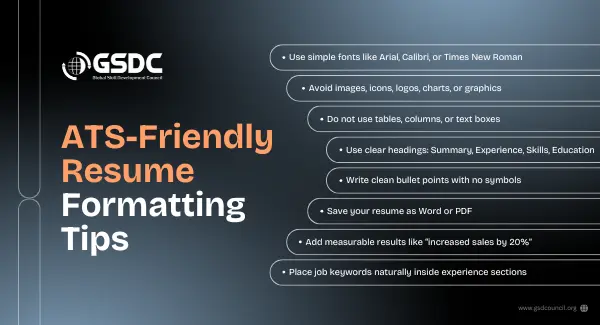
A key reason top talent doesn’t get interviews is that their resumes aren’t ATS-friendly. ATS software scans and filters resumes based on:
-
Keywords from the job description:
The system looks for terms the employer used in the job posting - missing key phrases can lower your chance.
-
Relevant skills match:
ATS checks whether your listed skills match what the job requires.
-
Simple and standard resume formatting:
This is because complex layouts, images, graphics, or fonts might confuse the system and make it fail to read your resume properly.
-
Evidence of measurable results and achievements:
Resumes with strong indicators of the outcomes, such as "increased sales by 20 percent," are more likely to advance through the hiring process.
Recently available data reveals that close to 98% of large corporations utilize ATS software to filter resumes; this implies that your resume needs to be optimized to be compatible with this software.
You could be applying for a position that would be perfect for you, but if your resume is not picked up on by the computer system or is lacking key keywords, it could never get to a hiring manager.
How ChatGPT Works as Your AI Resume Reviewer
Instead of guessing why your resume is not getting responses, you can use ChatGPT to see how it performs before you apply. It reviews your resume the way a screening system would and shows exactly what needs improvement.
ATS Match Score
Gives you a percentage score that shows how closely your resume matches the job description. A higher score means a better chance of getting shortlisted.
Missing Keywords
Identifies the key skills, tools, and terms required for the job that are not already on your resume to ensure you know what to incorporate.
Formatting Issues
Format Notes problems like tables, graphics, columns, or ambiguous headings that might inhibit resume-scanning software from correctly interpreting your resume.
Weak or Repeated Content
Helps identify areas on your resume that tend to express the same job duty information, which can make your resume more effective.
Achievement Gaps
Shows areas in the resume that mention work activities and not results, and how to incorporate results.
Improvement Suggestions
Proliferates clear ideas on rewrites of sections so that your resume becomes stronger, more relevant, and easier for both ATS and recruiters to understand.
Step-by-Step: Use ChatGPT for Resume Optimization
These steps help you turn ChatGPT into your personal AI career co-pilot for resume improvement.
Step 1: Select Your Target Job
Go to LinkedIn Jobs, Indeed, or Glassdoor and search for roles you're genuinely interested in.
Choose one role and copy the full job description.
This provides you with the exact language that the recruiters and ATS systems are using.
Step 2: Extract Important Keywords from the Job Description
Use this prompt:
“Act as an ATS resume analyst. Extract the essential skills, keywords, and responsibilities from this job description.”
Insert the job description. And ChatGPT will point out key skills, soft skills, tools, and job roles that must be included in a resume.
Step 3: Analyse Your Resume for ATS Compatibility
Now use this prompt:
“Compare this resume to the job description and give an ATS match score. Highlight missing skills, weak areas, and improvement suggestions.”
Paste the text for your resume here. A match score and a set of gaps between your resume and the job requirements will be provided.
Step 4: Understand Your ATS Match Score
|
Score Range |
What It Means |
|
Below 50% |
Your resume is missing many key elements |
|
50–70% |
Your resume is partly aligned but needs improvement |
|
Above 80% |
Your resume is strongly aligned with the role |
This score helps you decide whether to apply immediately or improve first.
Step 5: Improve Your Resume Content
Ask ChatGPT:
“Suggest how to rewrite my bullet points with clear, measurable achievements relevant to the job.”
Use the ideas to add results, numbers, and impact - but always rewrite in your own words.
Step 6: Retest and Refine
Having updated your resume, you can repeat the analysis. Further improve until you can maintain a score above 80% all the time, significantly increasing your chances of being shortlisted.
By following this approach, you will learn to view your resume not just as a static piece of paper, but rather as a dynamic tool for your job search. The role of ChatGPT is to help you understand perfectly what the hiring manager is searching for so that every application you fill out is better, more effective, and successful.
Create a Master Resume Using Multiple Job Descriptions
Instead of creating a new resume for every job, build one strong master resume that works across many roles.
-
Collect 10–15 similar job descriptions
Search for the same role across different companies. This shows you what employers consistently expect.
-
Ask ChatGPT to find common keywords
Use this prompt:
“Extract the common skills, tools, and responsibilities from these job descriptions.”
Paste all the descriptions together.
-
Determine common expectations
ChatGPT will show you the skills, tools, and areas of experience that are most commonly repeated – those are the "real" industry standards.
-
Create your master resume based on these words
Make sure that your resume has these words appearing organically within the responsibilities and accomplishments.
This master resume serves as your career foundation: saving you time and keeping your job applications on target with what employers are actually looking for.
Use AI for Interview Preparation Too
Once your resume is ready, it’s time to prepare for the most important stage - the interview. ChatGPT can work as your 24/7 interview practice partner.
-
Practise real interview formats
Prompt:
“Simulate a behavioural interview for this role.”
ChatGPT will ask you questions exactly like a recruiter would, helping you practise structured responses.
-
Prepare for problem-solving scenarios
Prompt:
“Give me common situational interview questions for this job.”
You’ll learn how to answer questions about conflict, leadership, failure, deadlines, and decision-making.
-
Improve communication and clarity
Prompt:
“Review my answer and suggest how to make it more confident and concise.”
This helps remove filler words and improve storytelling.
-
Build role-specific confidence
Prompt:
“What technical questions should I expect for this position?”
You’ll uncover areas you need to revise before the interview.
AI-driven preparation turns nervousness into readiness - so when the real interview comes, you already feel prepared.
What AI Should Not Replace
-
Your actual metrics and accomplishments
Only include results you personally delivered and that you can clearly explain. If you can't walk a recruiter through how you accomplished it, it shouldn't be on your resume.
-
Your personal career story
Your journey, career decisions, challenges, and growth are highly unique. AI is able to structure a story, but not live it.
-
Your Real Voice Through Your Resume
A phrase that is too perfect and generic lacks authenticity. What recruiters really want is clarity and integrity, not polish.
-
Your ethical judgment
You can get amazing suggestions from AI, but it is your duty to make sure all of this is accurate and true.
-
Your interview presence
Tone, attitude, body language, and illustrations should all emanate from you and not from a script.
You must never include any AI-powered statements that you could not explain thoroughly and defend during any interview.
From Resume to Results: Grow with GSDC’s Certified AI Tool Expert
GSDC takes professionals beyond the basic awareness stage to actual implementation through the Certified AI Tool Expert program. The focus of this certification is on practical use: optimizing AI tools for resumes, conducting a smarter job search, effective interview preparation, and general professional productivity.
It empowers you to apply AI responsibly, while keeping your work authentic: making sure your resume reflects real achievements, your interviews feel natural, and your career growth is fueled by skill, not shortcuts.
Final Takeaway: Leverage AI as Your Career Co-Pilot
The process of looking for a job does not have to be intimidating with uncertain outcomes. By incorporating the proper use of ChatGPT, as an AI-powered tool for the Resume Reviewer & Interview Preparation Assistant, you can enhance the visibility of your resume within the applications of an ATS system, ensure that all applications within the job search process are non-uncertain, build your professional brand, as well as be confident for an interview.
When leveraged correctly, AI will be your career co-pilot, assisting in sharpening your skills, your message, and your story, from passive uses to proactive in your development.

Related Certifications
Stay up-to-date with the latest news, trends, and resources in GSDC
If you like this read then make sure to check out our previous blogs: Cracking Onboarding Challenges: Fresher Success Unveiled
Not sure which certification to pursue? Our advisors will help you decide!