From PMO Professional to Practice: Case Studies & Industrial Applications

Written by Matthew Hale
There is a lot of pressure on businesses all over the world to finish projects on time, on budget, and in line with their strategic goals. A Project Management Office (PMO) helps a lot of people deal with this level of difficulty.
But for workers who want to move up in their careers, the big question is still: Is a certificate in project management worth it?
When we look at the change from getting certified to using what you've learnt, the answer becomes clear. The purpose of a certified professional project manager, the value of the online project management certification, and how certified PMO professionals are changing industries are all discussed in this piece.
What PMO Stands For and Why It Matters
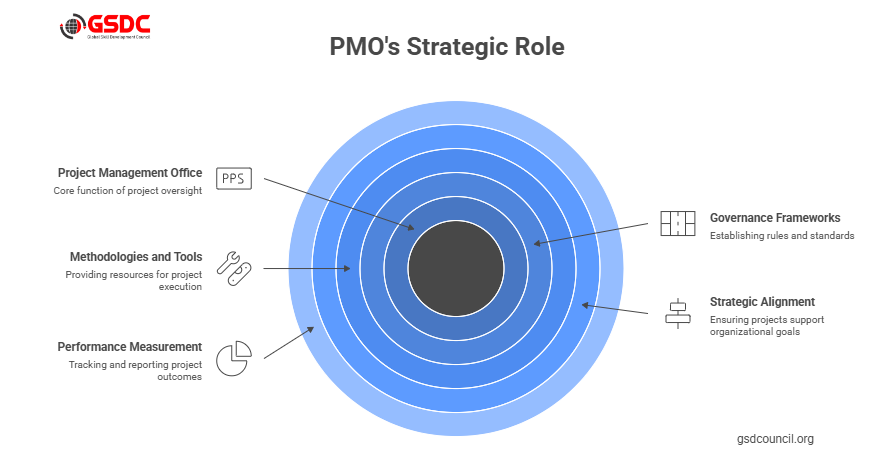
At its simplest, what PMO stands for is Project Management Office. But the project management office description extends beyond administration:
- Defining governance frameworks.
- Providing methodologies, templates, and tools.
- Aligning projects with organizational strategy.
- Measuring and reporting on portfolio performance.
The business PMO has evolved into a strategic driver. By 2025, PMOs will exist in 89% of financial services, 82% of aerospace, and 80% of telecom companies. This proves why every organization needs a PMO, not just to manage projects but to ensure long-term competitiveness.
About PMO Certifications
One of the most respected paths to PMO leadership is the Certified PMO Professional certification, offered by the Global Skill Development Council (GSDC).
This globally recognized project management office certification validates expertise in areas such as strategic planning, program and portfolio management, stakeholder engagement, governance, and performance measurement.
Earning the GSDC PMO certificate demonstrates mastery in aligning projects with organizational goals and driving efficiency.
Employers worldwide recognize it as proof of a professional’s ability to lead complex projects, implement best practices, and deliver measurable value.
For professionals considering whether a project management certificate is worth it, the GSDC credential offers a strong case. It not only boosts credibility but also unlocks opportunities in roles like project coordinator, PMO lead, or PMO professional.
From Certification to Practice
Completing a certification project management professional program provides the theoretical foundation, but the challenge lies in practice. Professionals must move from passing exams to applying frameworks in PMO cases that deliver real outcomes.
The PMO setup process & roadmap is where certified practitioners prove their value. They help organizations define governance, streamline processes, and create maturity models for sustainable growth.
Research shows that improving the competency of program managers doubles the likelihood of meeting all project goals. Certification ensures professionals have the skills required to step into leadership and apply governance in real-world situations.
Case Studies: How Certification Delivers Results
Ontario Power Generation (Energy Sector)
Ontario Power Generation (OPG) was having more and more problems with its big building projects, like delays, cost overruns, and issues fitting projects with the company's sustainability goals.
Because OPG knew that structured control was important, they set up an Enterprise PMO with certified professionals working for it. Many of them have credentials like the Certified PMO Professional certification.
The PMO made processes more consistent, made risk management systems better, and put in place dashboards to keep an eye on KPIs across all portfolios.
Certified professionals worked on strategic alignment, making sure that every project was linked to the organization's goals, like producing clean energy and following the rules.
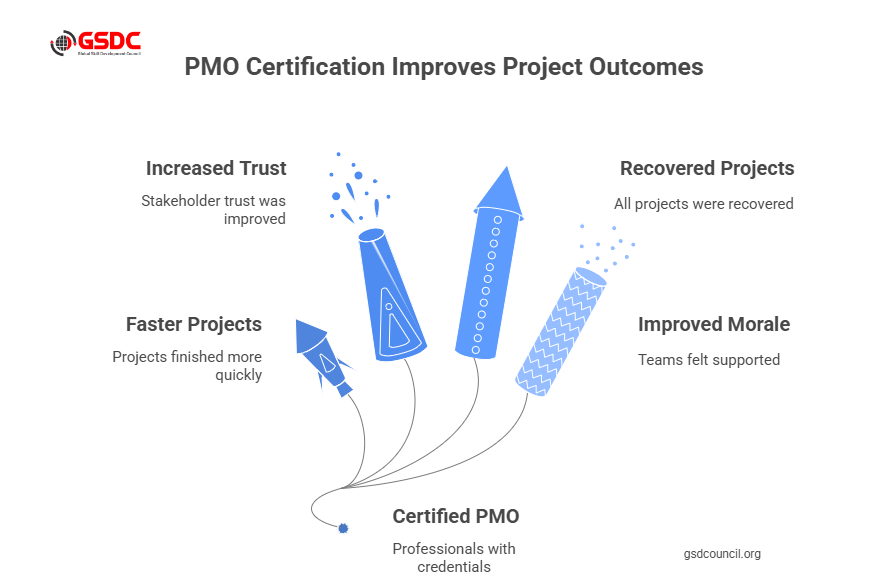
The results were amazing: OPG said that projects were finished faster, trust between stakeholders increased, and long-term energy goals were measured as progress. This case shows how certified practitioners help connect governance and effect in complicated fields.
Kettering Health Network (Healthcare Sector)
Kettering Health Network, a large U.S. healthcare provider, struggled with portfolio prioritization and inconsistent adoption of Agile practices across departments. This led to inefficiencies, duplicated efforts, and poor visibility into progress at the executive level.
By establishing a centralized PMO and hiring certified professionals, Kettering accelerated its Agile transformation. The PMO provided coaching, standardized governance models, and facilitated communication across multiple departments.
Leveraging the PMO setup process & roadmap, they defined a maturity model and began measuring success using standardized KPIs.
Within just a year, Kettering doubled its portfolio impact, delivering more projects aligned with strategic goals and significantly reducing time-to-market for healthcare innovations.
For a sector where patient outcomes depend on efficiency, the transformation demonstrated the real-world value of PMO-certified practitioners.
U.S. Staffing Firm (Recruitment Industry)
A leading staffing firm managing multimillion-dollar projects hit a breaking point when $13 million worth of client projects were deemed “at risk” or failing. These projects suffered from inconsistent reporting, weak risk management, and limited accountability.
The company turned to a certified PMO team, deploying governance frameworks and integrating advanced project management tools.
Certified practitioners retrained project managers, established new reporting structures, and prioritized active stakeholder engagement. Using methodologies learned during certification, the PMO created a transparent system where risks were tracked early and mitigation strategies were enforced.
The turnaround was swift: all $13 million in projects were recovered, client confidence was restored, and employee morale surged as teams felt supported rather than blamed.
This case underscores how investing in certified professionals can turn failing projects into success stories.
Lycodia Consulting (IT & Services Sector)
Lycodia, a global IT and consulting services company, experienced challenges with decision-making and delivery consistency across its complex project portfolio.
Projects often overran budgets, deadlines were missed, and executives lacked visibility into true performance.
To address this, Lycodia implemented a PMO grounded in portfolio management principles, staffed with certified professionals.
The PMO introduced structured governance, including stage-gate processes, KPI dashboards, and regular portfolio review meetings. Certified practitioners emphasized accountability while improving collaboration between business and IT functions.
The results were clear: transparency in decision-making improved, organizational agility increased, and delivery rates hit both on-time and on-budget targets. The PMO’s credibility grew, and the organization scaled its use of PMO frameworks across multiple divisions.
Assess your PMO’s maturity and identify improvement areas.Download this guide to:
Implement strategies to enhance PMO effectiveness.
Optimize project delivery and drive better outcomes.
Why These Case Studies Matter
One thing that all of these PMO cases have in common is that licensing by itself doesn't get things done, but when combined with practice, it makes leaders who can handle tough problems.
The jobs and duties of certified project management professionals make a real difference, whether they're recovering millions of dollars from failed projects, making healthcare more flexible, or making sure that energy supply is sustainable.
Industrial Applications Across Sectors
Certified PMO practitioners are making an impact in nearly every sector:
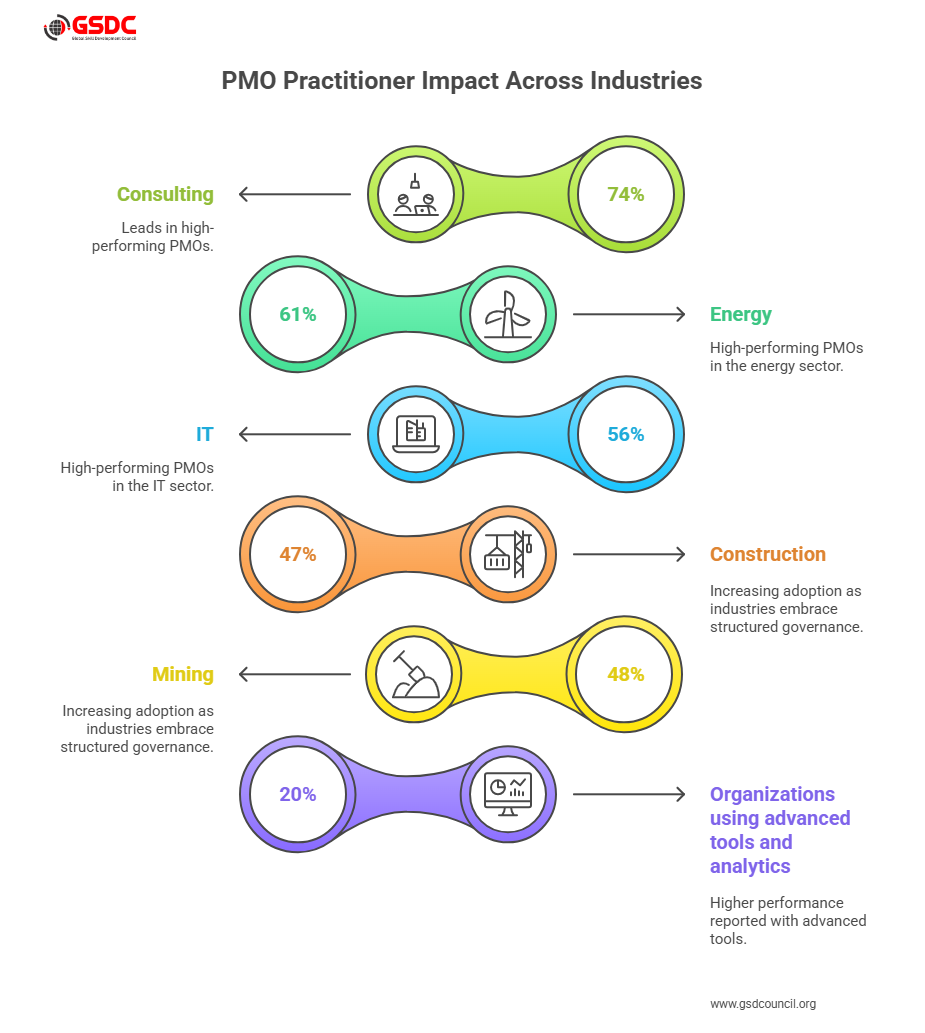
- Consulting (74%), Energy (61%), and IT (56%) lead in high-performing PMOs.
- Construction (47%) and mining (48%) show increasing adoption as industries embrace structured governance.
- Organizations using advanced tools and analytics report 20% higher performance.
-
This underscores why professionals must pair their PMO credential with tools & practical knowledge / exam preparation guide.
Digital transformation has also redefined PMOs. Companies increasingly build the Project Management Office with Gen AI, adopting AI-enabled analytics and dashboards.
With the project management software market expected to hit $7.24 billion in 2025, certified practitioners who embrace these technologies are leading the way.
Roles and Responsibilities of a PMO Certified Practitioner
The project management office job description varies across industries, but the roles and responsibilities of a PMO-certified practitioner typically include:
- Aligning projects with business objectives.
- Defining KPIs for success.
- Establishing governance frameworks.
- Driving stakeholder communication.
Yet only 45% of PMOs have clearly defined roles and responsibilities. This gap creates opportunities for certified professionals to step up and standardize processes.
Business PMO: A Strategic Necessity
The business PMO has shifted from administrative to strategic. It now plays a vital role in decision-making, resource allocation, and ROI measurement.
In fact, 69% of organizations say their PMO’s value perception has grown, and nearly half expect team expansion in 2025.
This shows why becoming a certified professional project manager or holding a GSDC PMO certificate is a career advantage.
Employers are actively seeking professionals who can lead business-critical PMO initiatives.
Career Path & Salary Growth
One key question is whether the project management certification online cost pays off. Research and industry demand suggest it does.
The career path & salary growth of a certified professional often includes:
- Entry-level project coordination.
- Mid-level project or program manager.
- Senior PMO leadership.
- Executive-level strategic roles.
The GSDC Certified PMO Professional certification strengthens this path by providing credibility and expanding career opportunities. PMI’s 2025 Talent Gap Report shows demand for certified practitioners continues to grow, outpacing supply.
Tools & Practical Knowledge
Certification builds foundations, but applying tools & practical knowledge / exam preparation guide makes the difference in practice. High-performing PMOs invest in:
- Portfolio management platforms.
- AI-driven reporting.
- Low-code/no-code tools.
- Collaborative dashboards.
Certified practitioners who master these tools succeed in bridging knowledge and impact, as proven in numerous PMO cases across industries.
Is a Project Management Certificate Worth It?
So, is a project management certificate worth it? For professionals and organizations alike, the answer is yes. Certified practitioners deliver higher project success rates, stronger stakeholder trust, and improved governance.
While some hesitate because of the project management certification online cost, the measurable return, such as higher salaries, broader opportunities, and stronger business outcomes, makes it a valuable investment.
The GSDC PMO certificate further adds credibility, signaling to employers that you are ready to lead transformation.
Conclusion
Certified workers show how PMOs change organisations in fields like energy, IT, healthcare, and consulting. The GSDC Certified PMO Professional certification proves knowledge, trains professionals for leadership, and lets them make a real difference in the business.
Professionals show that certification is more than just a badge of honor; it's a way to make a real difference through the PMO setup process and plan, the use of digital tools, and the application of governance frameworks.
The proof is strong for people who are trying to decide whether to go for a project management professional certification program or the GSDC PMO certificate. This investment leads to better job growth, more power in the organisation, and recognition across the whole industry.
Seeing the change from certified learning to real-world use shows why every company needs an organised and well-led PMO. The future is clear for workers who are ready to move from theory to practice: getting certified is the way to become a leader and have long-term success.
FAQs
1. What is a Project Management Office Certification?
A project management office certification validates your skills in governance, portfolio management, and project alignment. It proves you can set up and run a PMO that delivers measurable value to organizations.
2. Is a Project Management Certificate Worth It?
Yes. If you’re asking if a project management certificate is worth it, the answer is backed by data. Certified professionals earn higher salaries, enjoy faster career growth, and help organizations improve project success rates through structured PMO practices.
3. What PMO Stands For in Project Management?
What PMO stands for is Project Management Office. It’s a centralized function that defines standards, supports project teams, and ensures projects align with strategic business goals.
4. What is the Project Management Office Description?
A project management office description typically includes responsibilities like setting governance frameworks, monitoring project portfolios, and coaching project teams. The PMO ensures projects deliver consistent value and outcomes across the organization.
5. Why Do PMOs Fail?
Common reasons why PMO fails include a lack of executive support, poorly defined roles, inadequate performance measurement, and resistance to change. Certification-trained professionals can address these issues with structure and strategy.
6. How Does Project Management Office Certification Help Career Growth?
A project management office certification strengthens your professional credibility, making you eligible for PMO leadership roles. It also helps you master tools, governance practices, and strategic alignment, all key to advancing your career.
7. Can a Project Management Certificate Improve Organizational Performance?
Absolutely. Beyond answering, is a project management certificate worth it? Certified PMO professionals are shown to improve project completion rates, stakeholder trust, and ROI by applying structured frameworks.
8. How Can Organizations Avoid Why PMO Fails Scenarios?
Organizations can prevent PMO failure scenarios by defining clear responsibilities, aligning projects with strategy, and employing certified practitioners who understand governance, stakeholder engagement, and performance measurement.

Related Certifications
Stay up-to-date with the latest news, trends, and resources in GSDC
If you like this read then make sure to check out our previous blogs: Cracking Onboarding Challenges: Fresher Success Unveiled
Not sure which certification to pursue? Our advisors will help you decide!